
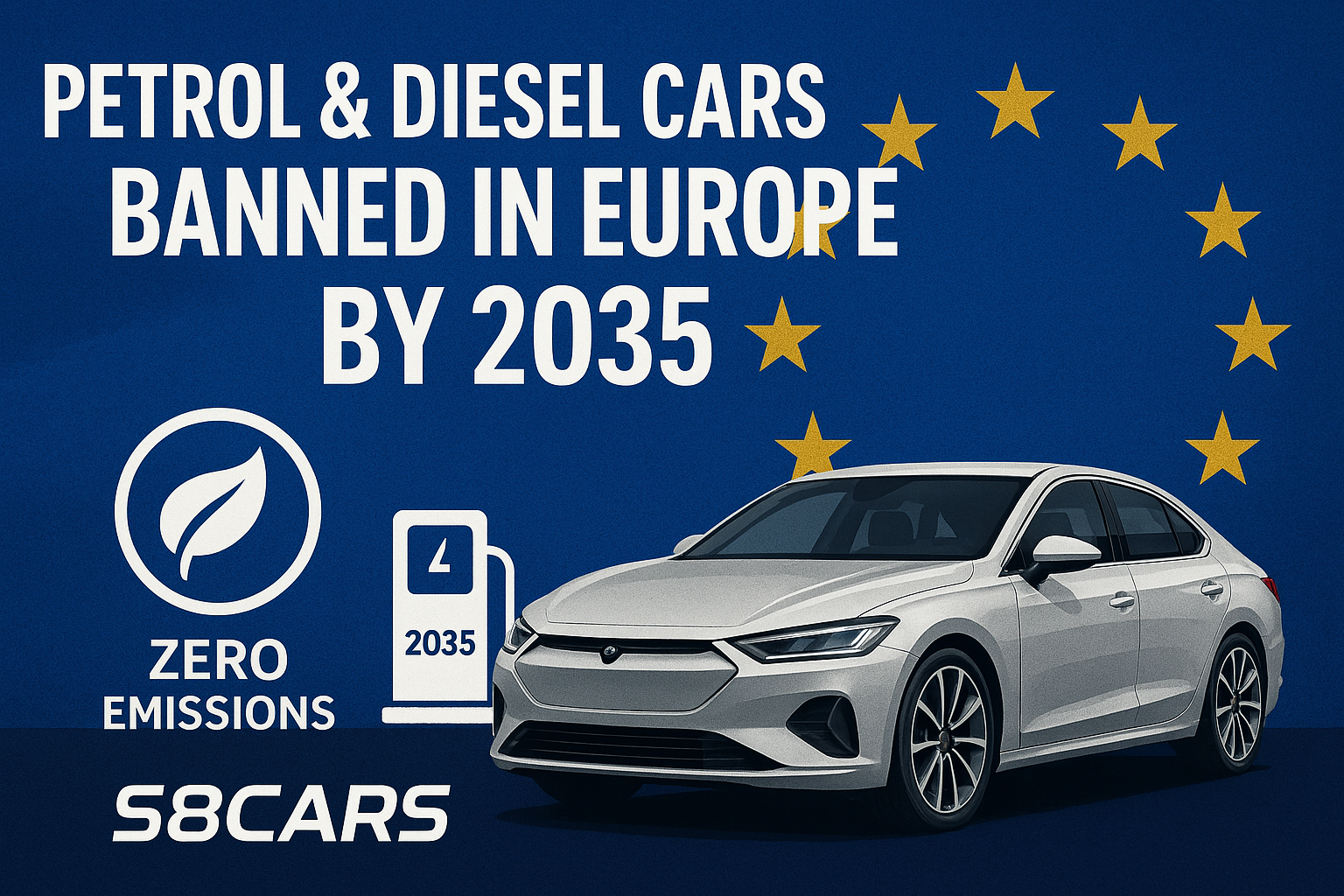

A bold step towards a greener future, the European Union has officially passed legislation that will ban the sale of new petrol and diesel cars from 2035. The decision is a key pillar of the EU’s long-term climate strategy, which aims to achieve net-zero carbon emissions by 2050.
The new regulation marks one of the most significant transformations in the history of the automotive industry, signaling the beginning of the end for traditional internal combustion engine vehicles across Europe.
What the 2035 Ban Means
From January 1, 2035, all new passenger cars and light commercial vans sold in the European Union must be zero-emission vehicles. This effectively means that only electric vehicles (EVs), hydrogen-powered vehicles, or other non-polluting technologies will be permitted for sale.
Petrol and diesel-powered cars, which have dominated global mobility for over a century, will no longer be allowed as new vehicle sales within the EU. Existing vehicles, however, will not be affected, and consumers will still be able to use, sell, or buy used combustion-engine cars beyond 2035.
The primary objective of this legislation is to drastically reduce CO₂ emissions from road transport, a sector that currently contributes nearly one-quarter of Europe’s total greenhouse gas emissions.
“This law is a historic step forward in the fight against climate change,” said an EU spokesperson. “It ensures the future of clean mobility in Europe while providing a clear direction for industry and consumers.”
Mixed Reactions from EU Member States
While environmental groups and clean energy advocates have widely welcomed the decision, the response from EU member states and the automotive industry has been divided.
Countries such as Germany and Italy raised concerns over the economic and industrial impact of the ban. Both nations are home to major automotive manufacturers and extensive supplier networks that rely heavily on internal combustion engine technology.
German automakers, in particular, expressed concerns about the pace of the transition. BMW CEO Oliver Zipse has publicly criticized the regulation, warning that a full ban on combustion engines could make Europe increasingly dependent on Chinese battery suppliers, potentially threatening European jobs and industrial competitiveness.
E-Fuels Exception: A Compromise Solution
After intense negotiations, Germany pushed for a compromise that would allow vehicles powered by e-fuels (synthetic fuels) to be sold even after 2035. These fuels are produced using renewable energy and are designed to be carbon-neutral.
The European Union accepted this proposal under strict conditions, stating that such vehicles must run exclusively on climate-neutral e-fuels and cannot be capable of operating on conventional petrol or diesel. While the exception remains limited, it offers a lifeline to manufacturers exploring alternative low-carbon technologies.
EV Adoption Already Accelerating
Despite opposition, the transition to electric mobility is already well underway across Europe. Major automakers including Volkswagen, Mercedes-Benz, Audi, and Volvo have announced plans to phase out internal combustion engines in Europe by the early 2030s.
Governments across the EU are also increasing investments in charging infrastructure, offering purchase incentives, and supporting domestic battery manufacturing to prepare for the shift. Public and private charging networks are expanding rapidly, particularly in urban areas and along major highways.
As EV technology improves and costs continue to decline, electric vehicles are becoming more accessible to a broader range of consumers.
What Comes Next for the Auto Industry?
As the 2035 deadline approaches, the automotive landscape is expected to change dramatically:
- Increased investment in EV production and battery technology
- Gradual decline of petrol and diesel model line-ups
- Greater focus on hybrid vehicles as a transitional solution
- Ongoing debates around hydrogen, e-fuels, and alternative mobility options
- Restructuring of supply chains and workforce skills
Automakers now face the challenge of balancing innovation, affordability, and sustainability while remaining competitive in a rapidly evolving market.
Key details of the EU 2035 vehicle emissions regulation are summarised below.
| Category | Details |
|---|---|
| Regulation start date | January 1, 2035 |
| Affected vehicles | New passenger cars and vans |
| Petrol and diesel sales | Banned for new vehicles |
| Allowed vehicle types | Electric, hydrogen, zero-emission |
| Existing vehicles | Not affected |
| E-fuels exception | Allowed under strict conditions |
| Climate target | Net-zero emissions by 2050 |
Quick Summary
- New petrol and diesel car sales banned in the EU from 2035
- Only zero-emission vehicles allowed for new sales
- Mixed reactions from EU nations and automakers
- Limited exception for e-fuels under strict rules
- Strong push towards electric and clean mobility
The EU’s decision represents a turning point not just for Europe, but for the global automotive industry, as other regions closely watch how this transition unfolds.
Read more international automotive news, EV updates, and future mobility stories on our website:
https://www.s8cars.com


I’m truly enjoying the design and layout of your website. It’s a very easy on the eyes which makes it much more pleasant for me to come here and visit more often. Did you hire out a developer to create your theme? Great work!
I am no longer sure the place you are getting your info, however good topic. I needs to spend some time studying more or figuring out more. Thank you for great information I used to be looking for this info for my mission.
Hi , I do believe this is an excellent blog. I stumbled upon it on Yahoo , i will come back once again. Money and freedom is the best way to change, may you be rich and help other people.
As I website possessor I believe the content material here is rattling excellent , appreciate it for your hard work. You should keep it up forever! Best of luck.